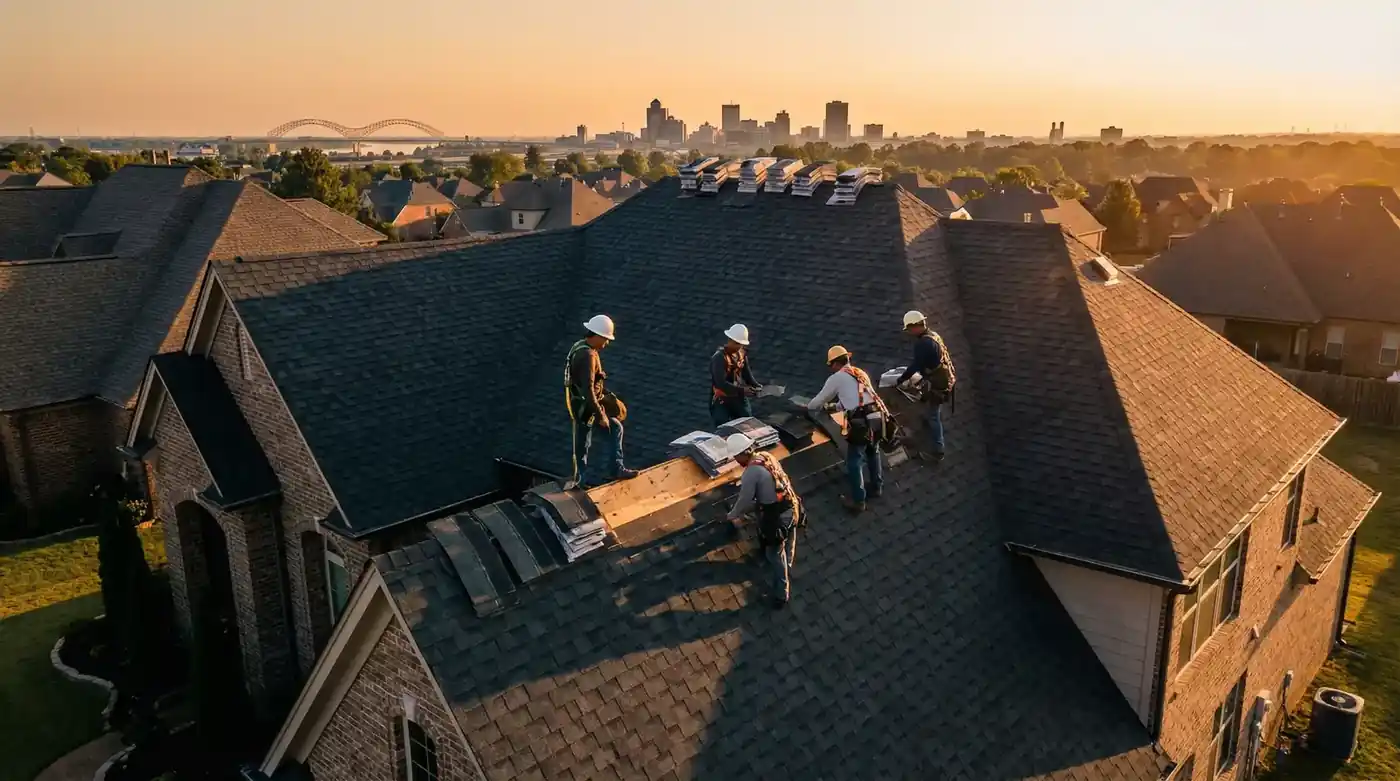
Roof ventilation matters in Memphis because our humid subtropical climate pushes hot, moisture-heavy air into your attic, and without a balanced system of intake vents (low, at the eaves) and exhaust vents (high, at the ridge), that moisture has nowhere to go. It condenses on the underside of your roof deck, rots the wood, feeds mold, ruins insulation, and quietly shortens the life of your shingles. Proper ventilation lets that hot, damp air escape and pulls fresh air in, keeping your attic close to the outdoor temperature and dry, which is exactly what a Mid-South roof needs to last.
Why Memphis Humidity Is So Hard on Attics
Memphis and the surrounding Mid-South sit in a humid subtropical zone. Summers are long, hot, and sticky, with dew points that routinely climb into the uncomfortable 70s and afternoon thunderstorms that dump moisture and then bake it in the sun. That combination of heat and humidity is the single biggest enemy of an attic: when the outdoor air is saturated and your attic can't breathe, the air inside gets even hotter and damper than the air outside. Homes from Germantown and Collierville to Bartlett, Cordova, and Arlington, and across the state line in Olive Branch, Southaven, and Hernando, all face the same physics. Warm, moist air rises into the attic from cooking, showers, and laundry below, and outdoor humidity seeps in through every gap. Without a clear exhaust path, that air just sits and condenses on cooler surfaces the moment temperatures dip overnight.
How Roof Ventilation Actually Works
A roof ventilation system is not one product but a balanced pair of openings that work together to create continuous airflow. Cool, fresh air enters low through intake vents (soffit, fascia, or eave vents), warms and rises, and exits high through exhaust vents (ridge vents, box vents, or fans). This is the stack effect, and it runs day and night with no moving parts. The key word is balance: intake and exhaust capacity should be roughly equal, with at least as much intake as exhaust, and every vent must connect to a clear attic cavity rather than being buried under insulation or sealed by a previous roofer's shortcut.
What Poor Ventilation Does to a Memphis Roof
- Condensation on the roof deck: moisture beads on the underside of the plywood or OSB, especially in fall and spring when nights cool quickly.
- Wood rot and delamination: repeated wetting weakens the decking until it sags, softens, or fails to hold nails.
- Mold and mildew: the dark, damp, still air of a poorly vented attic is ideal for mold, which can spread to framing and even into the living space.
- Ruined insulation: wet insulation flattens and loses its R-value, so your HVAC works harder and your bills climb.
- Premature shingle aging: trapped heat cooks shingles from below, causing curling, blistering, and granule loss years before the warranty period is up.
- Frost in cold snaps: on the rare Memphis hard freeze, attic moisture can frost on the deck and drip as it melts, mimicking a roof leak.
Signs Your Attic Isn't Breathing
- A hot, stuffy upstairs that your air conditioner can't keep up with in July and August.
- Higher-than-expected summer energy bills as the HVAC fights a superheated attic.
- Musty smells or visible black, gray, or green mold spotting on rafters and decking.
- Rusted nail tips or 'sweating' nails poking through the deck, a tell-tale sign of condensation.
- Shingles that look curled, blistered, or prematurely worn compared to neighbors' roofs.
- Peeling paint or wallpaper near the ceiling on the top floor.
Types of Roof Vents Compared
| Vent Type | Role | Best For | Notes |
|---|---|---|---|
| Soffit / eave vents | Intake | Almost every home | Essential low intake; often blocked by insulation and need baffles |
| Ridge vent | Exhaust | Roofs with a long, continuous ridge | Low-profile, even exhaust along the peak; pairs well with soffit intake |
| Box / static vents | Exhaust | Shorter or broken-up roof lines | Simple and reliable; several may be needed for enough airflow |
| Powered / solar fans | Exhaust | Attics with limited ridge or intake | Move a lot of air, but can short-cycle or pull conditioned air if intake is weak |
| Gable vents | Intake / exhaust | Older homes with gable ends | Can conflict with ridge systems; we evaluate before mixing types |
Ventilation, Storms, and Your Shingle Warranty
Memphis doesn't just deal with humidity; we get hail, high winds, and straight-line wind events that can tear at roof edges and vents. The right ventilation components are rated and installed to resist wind-driven rain and uplift, and after severe weather vents are one of the first things we check, because a dislodged vent can let water straight into the attic you worked to keep dry. If a storm has hit your home, a free inspection is the smart first step, and Rivet Roofing repairs storm-damaged roofs and vents fast to get your home weather-tight again. Ventilation also protects your manufacturer warranty: most manufacturers require adequate attic ventilation as a warranty condition. As a TAMKO Pro Certified contractor (Pro Platinum #175730) installing TAMKO Heritage architectural shingles, we build to the standards that keep those warranties intact and back our own work with a lifetime workmanship warranty.
What Does Fixing Ventilation Cost in Memphis?
Ventilation upgrades are usually one of the more affordable ways to protect a roof, especially compared to replacing rotted decking later. Adding soffit vents, cutting in a ridge vent, or installing static vents is typically a modest add-on when done during a repair or replacement. For context on the bigger picture, a full asphalt shingle roof in the Memphis area tends to fall in a typical range of roughly $4.50 to $8.00 per square foot installed, while metal roofing commonly runs two to three times that. Standalone ventilation work is far less, but the exact number depends on your roof, your existing vents, and any hidden damage, so the only honest price is one confirmed at a free, no-obligation inspection. Financing is available through Rivet Roofing if a ventilation fix turns into a larger repair once we open up the roof and find moisture damage underneath.
Permits, Codes, and Where We Work
Roofing and ventilation work is governed by local building codes that vary across the Mid-South, and code sets minimum vent-area requirements that a cut-rate job often ignores. Shelby County, Tennessee (Memphis, Germantown, Collierville, Bartlett, Cordova, Arlington, Lakeland, and Millington) and DeSoto County, Mississippi (Olive Branch, Southaven, and Hernando) each have their own permit and inspection processes, and we also serve communities across the river in East Arkansas. Rivet Roofing is licensed in Tennessee (GC #13153) and also in Mississippi and Arkansas, so we pull the right permits and build to code wherever you are.
Simple Maintenance to Keep Your Attic Dry
- Keep soffit vents clear: make sure attic insulation isn't packed against the eaves and choking off intake; baffles solve this.
- Vent bath and kitchen fans outside, not into the attic, so you aren't pumping moisture into the roof.
- Check vents after every major storm for dents, displacement, or debris.
- Watch your insulation: if it looks matted, stained, or smells musty, moisture is getting in somewhere.
- Schedule a free inspection at least once a year and after any hail or high-wind event.
Get a Free Ventilation Inspection From Rivet Roofing
In a climate as humid as the Mid-South, ventilation is not an upgrade; it is the difference between a roof that lasts its full life and one that rots from the inside out. If your upstairs runs hot, your attic smells musty, or you just want peace of mind before the next stretch of Memphis humidity and storms, Rivet Roofing will take a look at no cost and no obligation, and tell you honestly whether your roof is breathing the way it should. Call (901) 350-2870 or visit rivetroofingtn.com to schedule your free inspection. We also offer 24/7 emergency roofing when you can't wait.